History:


THE HUMBLE BEGINNINGS:
Around 1934, a group of like-minded sportsmen decided to get together and start a gun club. A charter was applied for and granted under the name "The Mystic Valley Gun Club". The group arranged to purchase a building for the club on the now non-existent Biltmore St in Malden. The club was located approximately where the back of the Malden Government Station "T" stop meets the McDonald Stadium. Many longtime members talk about attending the Juniors Program in the old building. Trophies and plaques at the club indicate MVGC was a very strong contender in the shooting leagues holding competitions in those years.
Unfortunately, most of the club's history has been lost. All of the founding members have passed on; Henry Gray, the last surviving Charter Member, passed in 1998. The older information presented here is word of mouth, having been passed down from year to year. We will update and fill in the gaps as more information becomes available. If you have photos or more information, please contact us. The following information is mostly about the buildings; information on the people will be added as it becomes available.
THE CURRENT CLUB BUILDING COMES TO BE:
When the city decided to allow the "T" Station to be built, the MVGC building was in the way. The city took the property from the club by eminent domain. As part of the settlement the club received a piece of property on Canal Street on which to build a new club. In the middle of an industrial area, this was one of the best places within the city limits to locate a gun club. Permits were applied for and granted, and construction of the new building began.
During a recent cleanout of the club, we came across some slides of the construction. They were in good condition and were scanned into digital files. It is interesting, when viewing these photos, to look at the background. Most of the buildings in the background no longer exist.
CONTINUING UPGRADES:
The Auxiliary Range
In the early 1990's the club was continuing to grow in membership. With the range in constant use by the various matches and the Pistol School, the general membership was being squeezed out of nighttime range use. On Saturday nights, there was a waiting list posted on the range door, and the ready room tables and chairs were all filled with shooters awaiting their turn to use the range. The need for more range space became apparent. Permits were granted and construction began on the auxiliary range. In the mid-1990s, construction was completed and the second range eased the congestion on the main range.
Caswell System
Also, during this time period, the main range received a major upgrade. The old hand-cranked target carriers and wooden shooting ports were replaced with, a then state-of-the-art Caswell Target system. At that time Caswell was installing these systems in police departments and government installations across the country. They reported we were the first private, 24-hour access range to install their system. It soon became apparent that the system would not hold up to our use. Misplaced shots from inexperienced shooters were wreaking havoc with the target turners. The turners were eventually be modified with a non-turning target-holding system of our own design that holds up to our heavy use.
Exhaust system
The exhaust system in use at that time was woefully inadequate. When many shooters were using the range at the same time, smoke was slow to clear. In matches, it sometimes got hard to see the targets. The range was also very cold in the winter months. We contracted for a high-volume air make-up system that combines high-volume air movement with a large in line heat system. This type of system was generally used in large restaurants, and this was one of the first times this type of arrangement was used in a shooting range. The range was now very warm in cold months, but it was not without its problems. Powder smoke would swirl around the Caswell system and slowly work its way to the exhaust fans. Conditions were almost as bad as with the old system. Smoke bombs were used to try and tune the system, but it soon became apparent that the only solution was to tear out the ducting and replace it with new, relocated ducts. This was done, and after some tuning it worked very well. We now have one of the best exhaust systems of any range around.
Backstop
The backstop in use at this time consisted of an angled steel plate and a bullet pit in the floor. The front of the opening was covered in a self-healing rubber called Line-a-Tex which was applied over a plywood base. This required continuous maintenance and replacement that would take a group of 6 to 8 members an entire Saturday several times a year--not to mention the cost of the materials. Several types of backstops were investigated, and a ground rubber tire backstop was decided upon. The range was closed for several weeks for the installation. The new backstop has worked very well. There is still a maintenance issue that has to be dealt with, but there is no backstop that doesn't require maintenance.
Henry Gray Award:
 Henry Gray: Founding member of Mystic Valley Gun Club
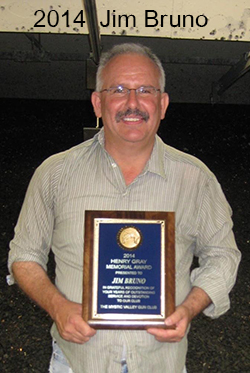
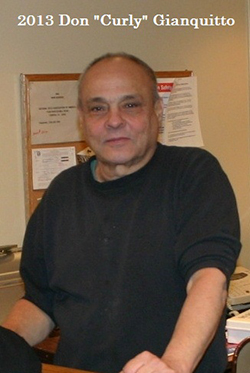
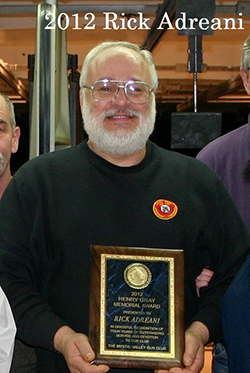
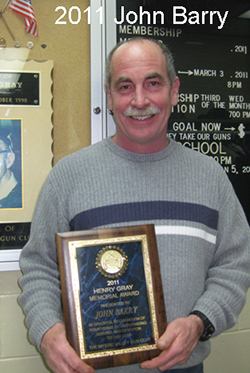
Each year the club awards the Henry Gray Memorial award to a deserving member who exhibits outstanding commitment to the Mystic Valley Gun Club. The award is named for the last surviving founding member of the club, Henry Gray. Many members will remember Henry for his work with the Juniors program and handgun tests for LTC applicants.
2024 Ronald Folger

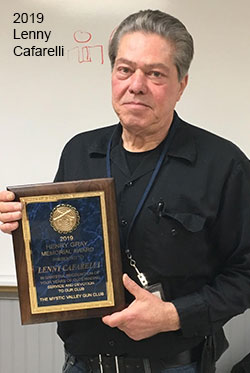
2019 Lenny Cafarelli
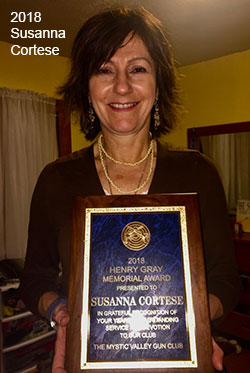
2018 Susanna Cortese
2017 Rich Sica
2016 Tom McInerney
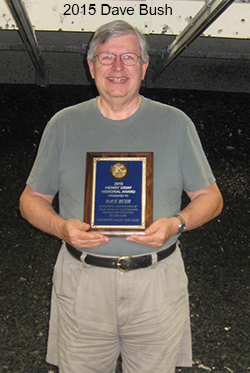
2015 Dave Bush
2014 Jim Bruno
2013 Don "Curly" Gianquitto
2012 Rick Adreani
2011 John Barry
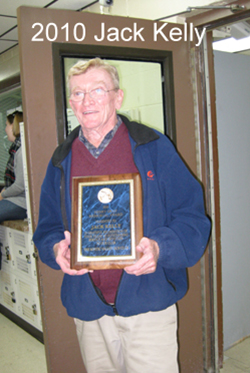
2010 Jack Kelly
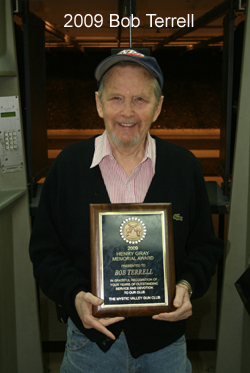
2009 Bob Terrell
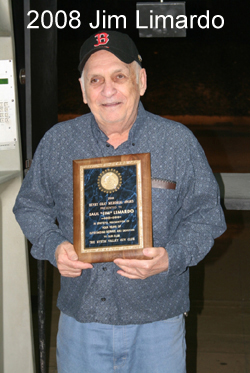
2008 Jim Limardo